
Introduction
Some patterns refuse to move, however much effort goes into them. You set the same goal every January and drift away from it by March. You have the same argument with different people. Or you feel a knot of dread around money, relationships or being seen, and logic cannot explain it. People in this position often start looking at what operates beneath conscious thought.
Subconscious Alchemy Sessions are one way of working with that deeper layer. In a guided, relaxed state, the session explores the beliefs, memories and emotional habits that quietly shape everyday choices. The aim is to understand them and loosen their hold. It is a reflective practice, not a medical treatment and not a prediction.
This article sets out the signs that such a session may be worth considering and explains what the experience involves. It separates spiritual interpretation from scientific evidence, and covers what to ask before you book. It also shows how this work sits alongside Vedic astrology and QHHT journeys, so you can decide which approach suits your question.
What Is a Subconscious Alchemy Session?
A Subconscious Alchemy session is a guided, one-to-one process. You are helped into a deeply relaxed, focused state so that beliefs, memories and emotional patterns operating below everyday awareness can be noticed and reframed. “Alchemy” points to transformation: turning stuck material into insight.
The subconscious here means mental activity that runs outside moment-to-moment attention. That includes habits, automatic reactions, early learned beliefs and stored emotional associations. Psychology describes related ideas as implicit beliefs and automatic processing, though terminology differs between schools. Indian philosophical traditions describe similar territory through samskaras, the impressions left by past experience.
A session is not a diagnosis, a forecast or a substitute for therapy. It is best understood as an experiential, reflective practice.
How a Session Typically Unfolds
Formats vary between practitioners, so confirm the details before you book. Most guided subconscious sessions follow a similar arc:
- A conversation about what you want to explore and what is going on in your life
- Guided relaxation and breathing to settle the body and quiet mental chatter
- Exploration of images, feelings or memories connected to your theme
- Integration, where the session closes gently and you discuss what surfaced
The pace is generally set around your comfort, and you can usually pause or stop. Ask any practitioner how consent and stopping are handled.
Seven Signs You Might Benefit from a Subconscious Alchemy Session
These signs are not diagnoses. They describe situations in which people commonly look for deeper self-exploration.
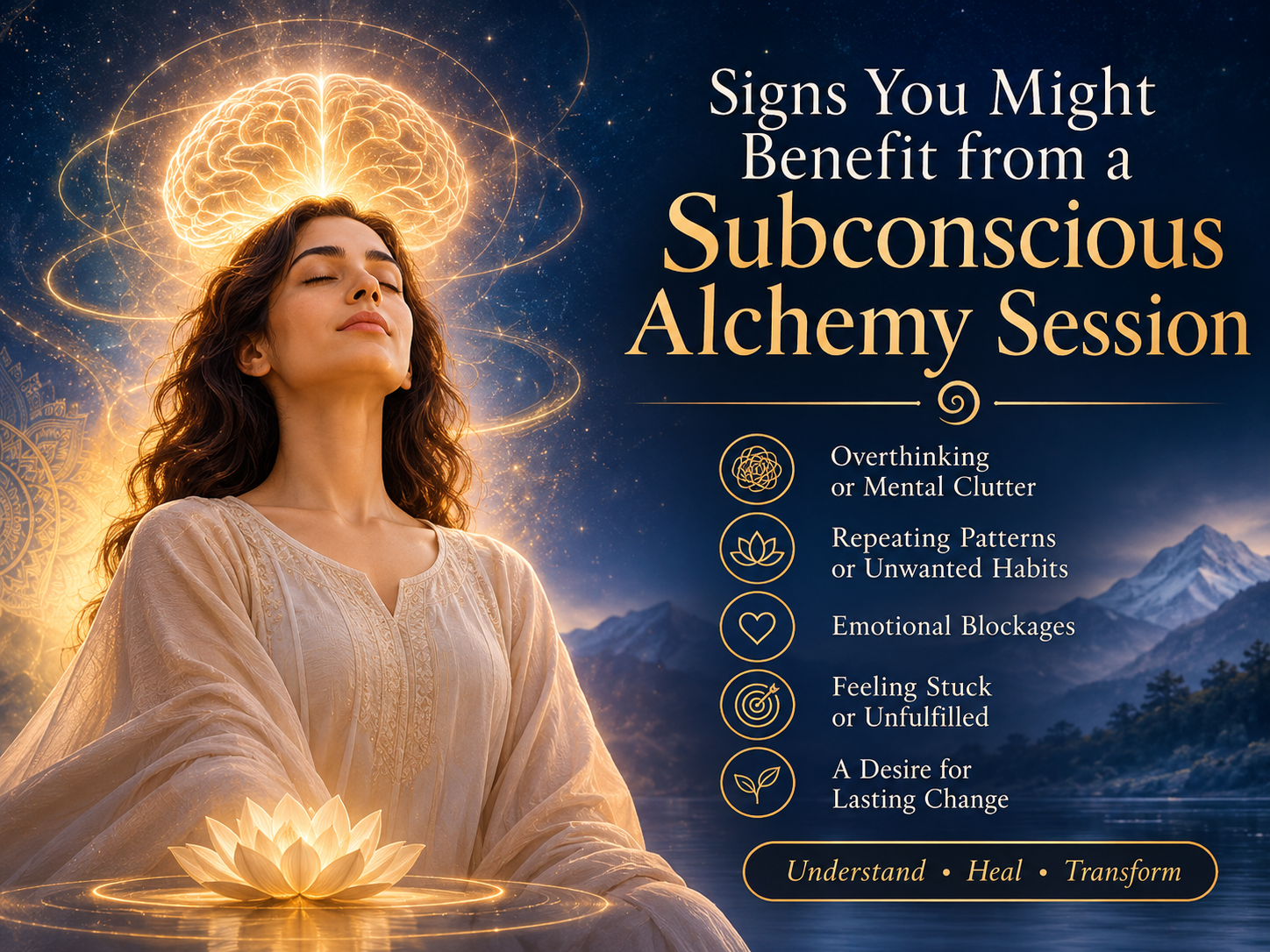
- You keep repeating the same pattern. Different job, different partner, same outcome. When the details change but the storyline does not, the pattern may be driven by an underlying belief rather than by circumstances.
- Your reactions are bigger than the trigger. A casual comment leaves you shaken for days, or a small delay sets off real panic. Disproportionate responses often point to older emotional associations being activated.
- You sabotage progress just as things improve. Procrastinating before a launch, ending a good relationship early or declining an opportunity you wanted can signal a conflict between what you want and what feels safe.
- You carry fixed beliefs about money, worth or deserving. Thoughts like “money is hard to keep” or “I am too much” or “not enough” often sound like facts. Many people absorb them from family and culture without ever examining them.
- You feel stuck despite doing everything “right”. You have planned, studied and followed advice, yet something holds you back. This gap between effort and movement is one of the most common reasons people try subconscious work.
- You feel emotionally heavy without a clear reason. This may include recurring dreams, a low background mood or a sense of carrying something that is not yours. If it is persistent, speak to a doctor or mental health professional first. Then consider a session as a complement, not a replacement.
- You are in a major transition and want clarity. Grief, relocation, a career change, a divorce or the end of a long chapter can all stir up unresolved material. A session offers structured time to reflect.
Signs That Point Elsewhere First
A session is not the right first step for every situation. If you are experiencing thoughts of self-harm, severe anxiety, panic attacks, symptoms of depression, or any unexplained physical symptom, see a qualified doctor or mental health professional first.
Guided regression-style work can also bring up strong emotion. People with a history of trauma, psychosis or serious mental illness should speak to their clinician before trying it. A responsible practitioner will ask about this during intake and will not position a session as an alternative to medical or psychological care.
Subconscious Alchemy Sessions, QHHT Journeys and Astrology: How They Differ
These three approaches are often confused because they overlap in audience, not in method.
- Subconscious Alchemy session: focuses on present-day patterns, beliefs and emotional habits, and how to shift them.
- QHHT journeys: QHHT stands for Quantum Healing Hypnosis Technique, a method developed by Dolores Cannon. It is built around deep trance work and can include past-life or “higher self” imagery. These ideas are spiritual beliefs, not scientifically established facts.
- Astrology consultation: Vedic astrology reads a birth chart (kundli), planetary periods called dashas and transits to discuss themes and timing. It is an interpretive tradition, not a predictive science.
Used together, they can complement each other. A chart may suggest a recurring theme, such as an emotionally intense Moon or a demanding Saturn period, and a session can give you a space to feel into it. If you are weighing the two, the article on Astrology vs Hypnotherapy explains where each fits. If a chart reading comes first, an astrology consultation Dehradun residents can book in person or online is a practical starting point, and your birth chart is the foundation for that discussion.
What the Research Says, and What It Does Not
Subconscious Alchemy as a named practice has not been tested in clinical trials. Its closest scientific relative is clinical hypnosis, which has been studied more.
Meta-analyses generally find hypnosis to be a very safe practice, and a 2019 Cochrane review found no evidence of harm, though evidence was not sufficient to show it outperforms other approaches for certain uses. The University of Wisconsin Integrative Health guide to clinical hypnosis summarises this literature clearly. The American Society of Clinical Hypnosis compiles research on hypnotherapy, and the US Department of Veterans Affairs has published an evidence map of hypnosis. Its VA Whole Health guide to clinical hypnosis notes the limits of the evidence base as well as its promise.
Two honest conclusions follow. Hypnosis-style relaxation has reasonable support for some uses, such as pain and sleep, and appears low-risk when practised responsibly. Claims about past lives, ancestral memory or energetic clearing fall outside scientific validation and are best treated as personal or spiritual interpretation. Some clinicians also caution that imagery produced in trance may not be an accurate record of events, so it is wise to treat it as symbolic.
How to Prepare for Your First Session
- Write down one or two themes you want to explore, rather than a long list
- Eat lightly and avoid alcohol beforehand
- Choose a time when you do not need to rush back to work or driving
- Keep water and a notebook nearby for afterwards
- Mention any medical or mental health history during intake
Go in curious rather than expecting a dramatic outcome. Many people describe subtle shifts in perspective rather than a single breakthrough, and results differ from person to person.
Questions to Ask Before You Book
Whoever you choose, ask how the session is structured, how long it lasts and what training or background the practitioner has. Ask what happens if difficult emotions arise, and whether the session can be paused. Ask what the practitioner does and does not claim.
Be cautious about anyone who guarantees results, promises to “remove” problems permanently or discourages you from seeking medical care. If you decide to Consult Charul Sharma, you can raise these questions at the start, along with your goals, so the session fits what you actually need.
A Note for Readers in Dehradun and Uttarakhand
Many people exploring this work are already familiar with the region’s strong meditation and wellness culture, from Rishikesh and Haridwar to Mussoorie. If you are searching for an astrologer in dehradun who also offers subconscious and regression-style work, look for someone who keeps the traditions clearly separate and explains each one honestly. Confirm whether sessions are available in person, online or both, and what languages are used.
Frequently Asked Questions
1. What is a Subconscious Alchemy session?
It is a guided, relaxed-state session that helps you explore beliefs, memories and emotional patterns operating outside everyday awareness. The goal is insight and change in how you respond, not prediction or medical treatment.
2. How do I know if I need one?
Common signs include repeating the same life patterns, out-of-proportion emotional reactions, self-sabotage and stubborn beliefs about money or worth. None of these is a diagnosis. If symptoms are severe or persistent, see a doctor or therapist first.
3. Is a Subconscious Alchemy session the same as hypnotherapy?
They overlap, because both use relaxation and focused attention. Clinical hypnotherapy is delivered by trained health professionals for defined conditions. A spiritual or alchemical session is usually more exploratory and symbolic, so ask each practitioner how they define their work.
4. How is it different from QHHT?
QHHT journeys use deep trance and often involve past-life or higher-self imagery. A Subconscious Alchemy session generally focuses on current patterns and beliefs. Confirm the exact approach with the practitioner.
5. Can astrology and subconscious work be combined?
Yes. A birth chart can point to recurring themes, and a session can give you space to explore how they feel. Treat the chart as an interpretive guide and the session as a reflective practice, not as certainties.
6. Should I Consult Charul Sharma before or after a medical appointment?
If you have physical or emotional symptoms that worry you, see your doctor first. For reflective, non-medical goals, you can Consult Charul Sharma at any point, and sessions are best treated as a complement to professional care.
Conclusion
Signs like repeating patterns, outsized reactions, self-sabotage and a sense of being stuck do not mean something is wrong with you. They often mean a long-held belief is steering decisions without being examined. A guided session offers a structured way to look at it.
Approach it with realistic expectations. The practice is reflective rather than predictive, and its spiritual claims sit outside the reach of science. Where it helps, it tends to help by creating space for honest self-observation.
CTA
If you recognise yourself in several of these signs, you can explore Subconscious Alchemy Sessions with Charul Sharma and discuss whether the format suits your situation. For a birth chart reading, you can also book a consultation for astrology guidance in Dehradun. Consult Charul Sharma to talk through your goals and choose the approach that fits you, with no promises of fixed outcomes.