

Introduction
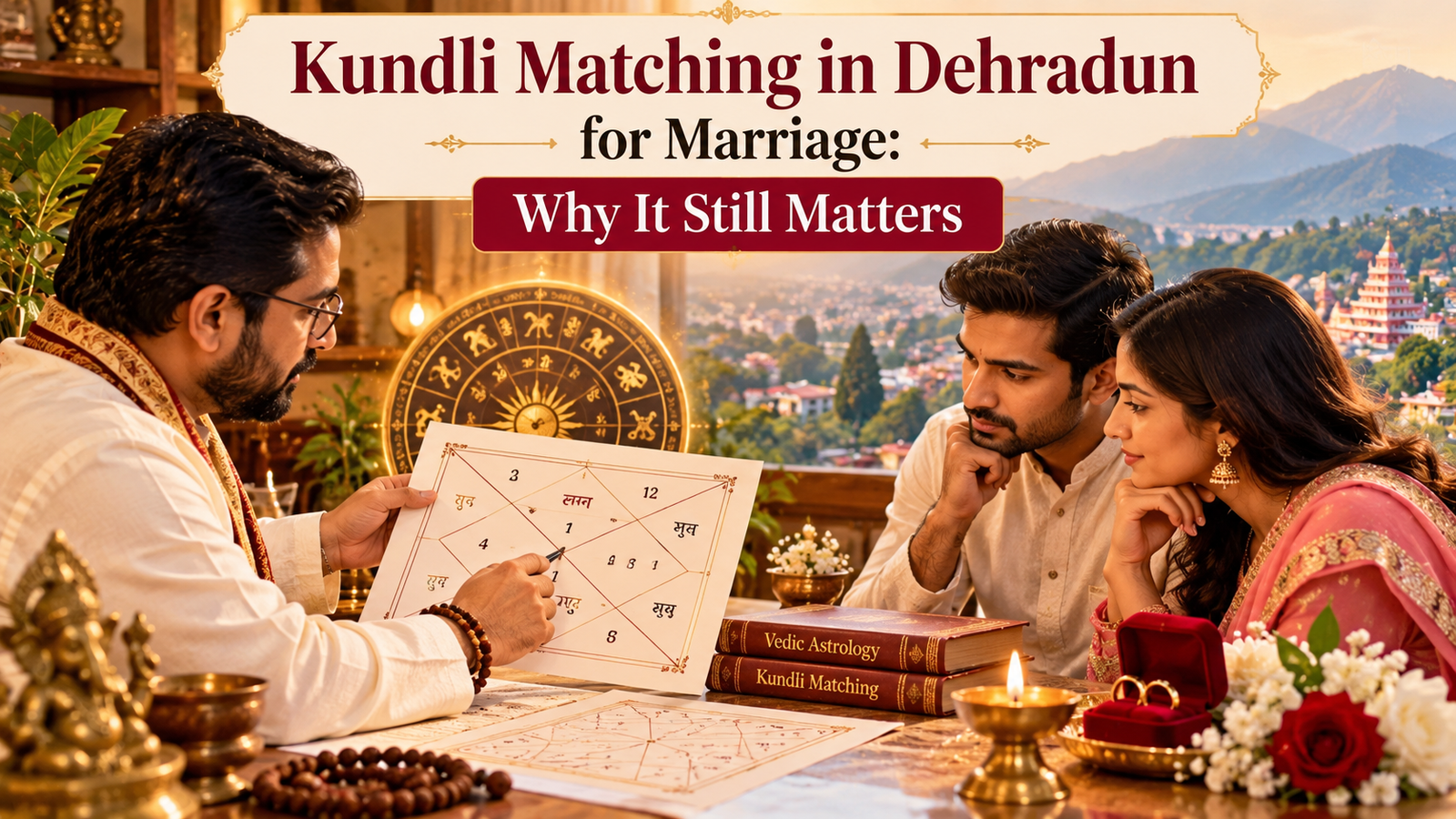
Kundli matching is the traditional practice of comparing two birth charts before marriage, and many families across Uttarakhand still treat it as an early step once a match is being discussed. If you are searching for kundli matching in Dehradun, you are most likely trying to settle a practical question: what does the process actually involve, and how much weight should it carry in a decision this important?
The honest answer sits between two extremes. Some families will not proceed unless the score reaches 18 out of 36, while others dismiss the whole exercise as superstition. Neither position helps a couple much. Kundli matching is best understood as one input among several, alongside shared values, family circumstances, finances, and the couple’s own judgement of each other.
This guide explains how Ashtakoot Guna Milan works, what a score really tells you, which dosha concerns deserve attention and which are often overstated, and where the scientific evidence stands. You will also find practical advice on when to get charts compared, what birth details to prepare, what to ask before you book, and how to tell a careful astrologer from a careless one in a city where many options compete for attention.
What Is Kundli Matching, and Why Do Families Still Ask for It?
Kundli matching, also called horoscope matching or kundali milan, is the comparison of two people’s Vedic birth charts to assess compatibility for marriage. The comparison draws mainly on the Moon’s position at birth, the strength of the 7th house of partnership, and the timing of each person’s planetary periods.
The practice has lasted because marriage in India is widely seen as a union of two families, not only two individuals. A chart comparison gives both sides a shared framework for discussion, and for many households it carries real religious and cultural weight. It is a tradition, not a legal requirement. The Hindu Marriage Act, 1955 sets out the conditions for a valid Hindu marriage, and horoscope matching is not among them.
How Does Ashtakoot Guna Milan Work?
Ashtakoot Guna Milan is the method most North Indian families use. It compares the Moon sign (rashi) and birth star (nakshatra) of both partners across eight categories, called kootas, for a maximum of 36 points. Each koota is traditionally linked to a different area of married life:
- Varna (1 point): temperament and ego compatibility
- Vashya (2 points): mutual attraction and influence
- Tara (3 points): well-being and birth star harmony
- Yoni (4 points): physical and instinctive compatibility
- Graha Maitri (5 points): mental rapport and friendship
- Gana (6 points): basic nature, classed as Deva, Manushya or Rakshasa
- Bhakoot (7 points): emotional bond and family welfare
- Nadi (8 points): health and constitution
These associations come from traditional texts and practitioner interpretation, not from measurable science. Dehradun families come from many regional backgrounds, and some follow the ten-porutham system used in South India, so it helps to tell your astrologer which tradition your family follows.
What Does a Guna Milan Score Actually Mean?
A score of 18 out of 36 is the traditional minimum for going ahead. Many practitioners read the range loosely: below 18 is considered unfavourable, 18 to 24 acceptable, 25 to 32 good, and 33 or above very good. The bands differ between astrologers, so treat them as a guide rather than a standard.
More importantly, the score is a screening tool, not a verdict. It looks mainly at the Moon in each chart and says nothing directly about the 7th house, the Navamsa chart, or the planetary periods the couple will pass through. A pair scoring 29 can still have an afflicted 7th house, and a pair scoring 20 can have strong charts with supportive timing. That is a practitioner’s view of how the method should be used, which is why a serious reading never stops at the number.
What Else Does a Complete Chart Comparison Include?
A thorough comparison reads both charts in full. The usual areas are:
- 7th house and its lord: the main indicator of partnership in each chart
- Venus and Jupiter: traditional significators of marriage, read by sign, house and strength
- Navamsa (D9): the divisional chart traditionally used to judge the depth and durability of a marriage
- Moon placement: a guide to emotional temperament and how each person responds to stress
- Dasha timing: whether each partner’s running and upcoming Vimshottari dasha periods support settling down, and whether both enter demanding phases together
- Mangal dosha: the placement of Mars, discussed below
Mangal Dosha and Nadi Dosha: Which Concerns Deserve Attention?
Mangal dosha, often called Manglik, is considered present when Mars sits in certain houses from the Ascendant, most commonly the 1st, 4th, 7th, 8th or 12th, with some traditions adding the 2nd and also counting from the Moon or Venus. It is the most misunderstood concern in matching. Many astrologers treat it as reduced or cancelled when both partners have it, or when Mars is strongly placed, for example in its own sign. A Manglik label alone is not a reason to reject a proposal. The placement, the sign and the rest of the chart all matter.
Nadi dosha arises when both partners share the same Nadi (Aadi, Madhya or Antya) and the Nadi koota scores zero out of eight. Traditional texts link it to health and children. That is a traditional belief, not a medical finding. Couples with genuine health or fertility questions should speak to a qualified doctor, and an astrologer who uses fear to sell an expensive ritual is a warning sign in itself.
Why Kundli Matching Still Matters for Marriage
What It Can Offer a Couple
Used sensibly, kundli matching gives families something concrete to work with:
- A structured conversation about temperament, expectations and timing
- An early view of areas in the charts that may need extra attention
- Shared reassurance for parents and elders, which matters in many households
- Planetary-period context when choosing how and when to move forward
It does not predict a happy marriage or an unhappy one. It offers an interpretation, and what the couple does with it remains their decision.
What Does Science Say About Kundli Matching?
Astrology is not supported by scientific evidence as a way to predict personality or compatibility. The best-known test is a double-blind study by physicist Shawn Carlson, published in the journal Nature in 1985, in which astrologers could not match natal charts to personality profiles at better than chance levels. Relationship research, meanwhile, generally points to communication, shared values and the way partners handle disagreement as central to a lasting marriage.
That does not make the tradition meaningless to the families who value it. It means kundli matching should be treated as a cultural and interpretive practice, never as a substitute for meeting, talking through finances, careers, children and living arrangements, or for medical, legal and counselling advice where those are needed.
How to Approach Kundli Matching Properly in Dehradun
A few practical points make kundli matching in Dehradun smoother, whether both families live in the city or one side is arranging the match from elsewhere.
What Birth Details Do You Need?
Both partners need a date of birth, an exact time of birth and a place of birth. Take these from a birth certificate or hospital record rather than memory. A difference of a few minutes can change the ascendant degree and the divisional charts, and when the Moon is close to a sign or nakshatra boundary it can change the Moon sign or pada. If a birth time is uncertain, say so before the session, because birth-time rectification can be discussed. Understanding how a birth chart is built also makes the comparison much easier to follow.
Common Mistakes to Avoid
- Relying on a free app score alone, with no reading of the full charts
- Treating a dosha as an automatic rejection
- Ignoring dasha timing, which shows how each phase of life may unfold
- Accepting costly remedies or gemstones as a condition of approval
- Leaving matching until after the venue is booked
- Confusing matching with muhurta: matching asks whether two charts work together, while muhurta selects an auspicious date
When Should Kundli Matching Be Done?
Ideally after both families have shown serious interest and before an engagement or roka is finalised. At that stage questions can be raised openly, and nobody has made commitments that are hard to reverse. If a wedding venue in Mussoorie, Rishikesh or Haridwar is being considered, completing the matching first avoids reworking dates later.
Kundli Matching in Dehradun: Online or In Person?
Because the analysis depends only on birth data, an online session works as well as one held in person. Parents may meet the astrologer in Dehradun while a partner working in Delhi NCR or abroad joins by video. Choose whichever format is more comfortable for everyone involved.
When choosing an astrologer, look for these signs:
- Both full charts are read, not just a software score
- The reasoning is explained in plain language, including strengths and cautions
- No guarantees are made about outcomes
- There is no pressure to buy gemstones or rituals
The guide on how to choose the best astrologer in Dehradun covers this in more detail.
Charul Sharma’s background is in classical Vedic astrology, with more than a decade of study and practice. Her matching work goes beyond the 36-point score: both charts are studied for 7th house strength, Mangal dosha, dasha compatibility and emotional temperament. Families who consult Charul Sharma can choose Hindi or English, and sessions are held in person in Dehradun or online. You can read more about the available Astrology Consultations before deciding on a format, and book a consultation once you are ready.
Frequently Asked Questions
1. What is kundli matching?
Kundli matching is the comparison of two Vedic birth charts to assess compatibility before marriage. It combines the 36-point Ashtakoot Guna Milan score with a study of the 7th house, Mangal dosha and planetary periods.
2. How many points are needed in kundli matching for marriage?
Traditionally, at least 18 out of 36 points. Scores of 25 or more are generally read as good. Astrologers differ on the exact bands, and the score should be read alongside the full chart comparison.
3. Is kundli matching necessary for marriage?
No. It is not a legal requirement, and the Hindu Marriage Act, 1955 does not mention it. It is a cultural and religious tradition that families choose to follow or not.
4. What if one partner has Mangal dosha?
It does not automatically rule out a match. Many astrologers consider the dosha reduced or cancelled when both partners have it or when Mars is strongly placed, so the full chart should be examined before any conclusion is drawn.
5. What details are needed for online kundli matching?
The date, exact time and place of birth of both partners. A birth certificate or hospital record is the most reliable source for the time of birth.
6. Is kundli matching scientifically proven?
No. Controlled tests have not shown that astrologers can match charts to personality at better than chance levels. It is best treated as a traditional, interpretive practice and not a prediction of marital success.
7. When should someone consult an astrologer about kundli matching?
Before an engagement is finalised and before wedding dates or venues are fixed. To consult Charul Sharma, share both partners’ birth details in advance so the charts can be studied before the session.
Conclusion
Kundli matching remains relevant because marriage in India involves families, traditions and shared reassurance as much as two individuals. Used with care, it gives couples and elders a structured way to discuss temperament and timing. It cannot guarantee how a marriage will turn out, and it works best alongside honest conversation, practical planning and the couple’s own judgement. A careful reading looks at both full charts rather than a single score, and treats every dosha with proportion instead of fear.
CTA
If you would like a careful, unhurried comparison of two charts, you can book a consultation with Charul Sharma for kundli matching in Dehradun, in person or online, in Hindi or English. If it is your first session, the guide on what to expect in a first astrology consultation explains how it works. For a wider introduction to her practice, visit the best astrologer in Dehradun page. To consult Charul Sharma, send both partners’ birth details along with any specific questions, and the charts will be studied before you meet.


1 Comment