
Introduction
Nakshatras are the 27 lunar constellations of Vedic astrology, each covering 13 degrees 20 minutes of the sky along the Moon’s path. When someone says they are a Rohini or Magha person, they are naming the nakshatra the Moon occupied at the moment they were born. That single placement, known as the janma nakshatra, sits at the centre of how Indian astrologers read temperament, timing and compatibility.
The system is older than the twelve-sign zodiac most people know. References to the lunar mansions appear in early Vedic literature, and most historians of astronomy believe the zodiac signs entered Indian astrology later. Today the nakshatras still guide kundli analysis, dasha calculations, marriage matching, naming ceremonies and the choice of auspicious dates.
This guide explains what the nakshatras are, how the 27 are arranged, what padas and ruling planets mean, and how to find your own birth star. It also separates traditional interpretation from scientific evidence, and it explains what to look for in the best astrologer in Dehradun if you want a reading built on your own chart rather than a general description.
What Are Nakshatras in Vedic Astrology?
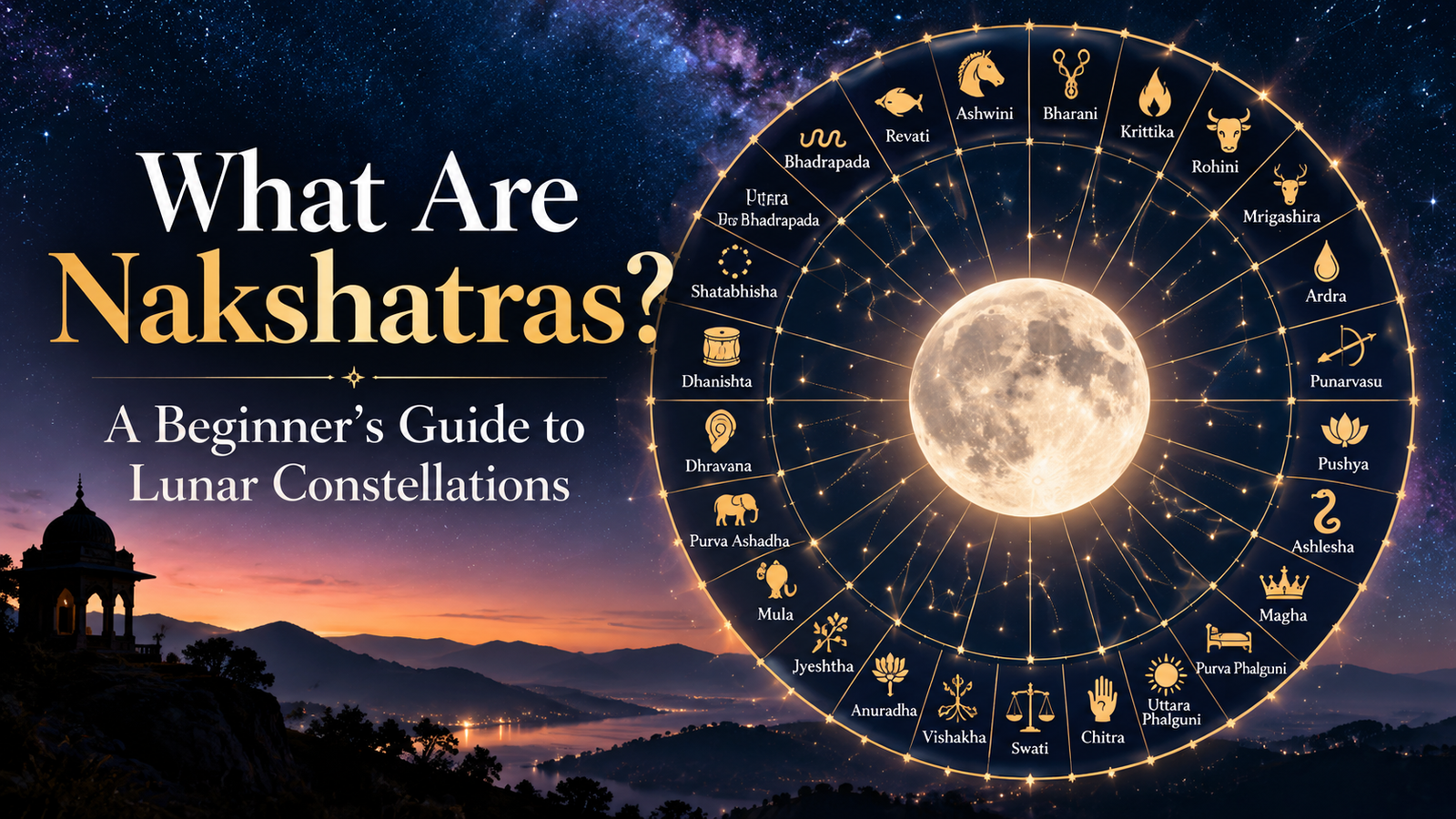
A nakshatra is one of 27 equal divisions of the zodiac belt, each spanning 13 degrees 20 minutes and named after a star or cluster of stars near the Moon’s path. The Moon takes about 27.3 days to complete one circuit against the background stars, so it spends roughly one day in each nakshatra. The word is usually translated as “star” or “asterism,” but in practice it works as a lunar address.
Vedic astrology treats the Moon as the significator of mind and emotional nature. For that reason, the nakshatra the Moon occupies at birth is read as a finer description of temperament than the Moon’s sign alone. That is the traditional view. The star groups themselves are real, but the meanings attached to them belong to astrological tradition, not to measured science.
How Many Nakshatras Are There, and in What Order?
There are 27 in the standard system. The sequence begins at 0 degrees of sidereal Aries and ends at the close of Pisces, so each sign holds two and a quarter nakshatras.
In order, they are:
- Ashwini
- Bharani
- Krittika
- Rohini
- Mrigashira
- Ardra
- Punarvasu
- Pushya
- Ashlesha
- Magha
- Purva Phalguni
- Uttara Phalguni
- Hasta
- Chitra
- Swati
- Vishakha
- Anuradha
- Jyeshtha
- Mula
- Purva Ashadha
- Uttara Ashadha
- Shravana
- Dhanishta
- Shatabhisha
- Purva Bhadrapada
- Uttara Bhadrapada
- Revati
Some texts add Abhijit as a 28th, placed between Uttara Ashadha and Shravana. It is used mainly in muhurta, the selection of auspicious timing, and does not take part in the standard 27-part chart division or the dasha system.
What Are Padas?
Each nakshatra is divided into four padas, or quarters, of 3 degrees 20 minutes each. Across 27 nakshatras that gives 108 padas, and every pada corresponds to one navamsa, the ninth divisional chart. The pada therefore tells an astrologer which navamsa sign the Moon occupies, which sharpens the reading. Traditionally, each pada is also linked to a starting syllable used when choosing a baby’s name.
Nakshatra Lords and the Dasha System
Each nakshatra is ruled by one of nine planets, in a fixed sequence that repeats three times: Ketu, Venus, Sun, Moon, Mars, Rahu, Jupiter, Saturn and Mercury. Ashwini, Magha and Mula belong to Ketu. Bharani, Purva Phalguni and Purva Ashadha belong to Venus. The pattern continues until Revati, which is ruled by Mercury.
This matters because the lord of your birth nakshatra decides the first period in your Vimshottari dasha, the 120-year planetary timing system. If the Moon was in Rohini, which Moon rules, life begins in a Moon dasha. How much of it remains at birth depends on how far the Moon had travelled through Rohini.
How to Find Your Birth Nakshatra
Your birth nakshatra is the one the Moon occupied when you were born. Finding it takes four steps:
- Gather your exact date, time and place of birth.
- Cast a sidereal chart, as Indian astrologers do, commonly using the Lahiri ayanamsa.
- Note the Moon’s longitude in that chart.
- Divide the longitude by 13 degrees 20 minutes. The whole number plus one gives the nakshatra’s position in the sequence.
For example, a Moon at 45 degrees gives 3.375 when divided by 13.33. That falls in the fourth nakshatra, Rohini, and the remainder places it in the second pada.
Birth time matters more than most people expect. The Moon moves about 13 degrees a day, so an error of a few hours can change the pada and, near a boundary, the nakshatra itself. This is why a carefully cast birth chart (Kundli) is the starting point for any nakshatra reading.
What Traditional Astrology Says Nakshatras Reveal
Each nakshatra carries traditional associations: a ruling planet, a presiding deity, a symbol and a general nature. Practitioners use these to describe tendencies and temperament, not fixed outcomes. Three examples show how the tradition works:
- Ashwini is linked with the Ashwini Kumaras, the divine physicians, and is associated with speed, initiative and healing.
- Rohini is associated with growth, beauty and abundance, and is ruled by the Moon.
- Pushya is associated with nourishment and care, is ruled by Saturn, and is traditionally considered favourable for beginnings.
Beyond personality, the birth star feeds into guna milan in kundli matching, muhurta selection, and tara bala, which compares the nakshatra of a day with your own. These are interpretations handed down through classical texts and practitioner experience. They offer a framework for reflection, not a forecast of events.
Nakshatra vs Moon Sign: What Is the Difference?
The Moon sign tells you which of 12 signs the Moon occupied, while the nakshatra tells you which of 27 segments it occupied, so the nakshatra is the finer measure.
- Moon sign: 12 divisions of 30 degrees, describing broad emotional style.
- Nakshatra: 27 divisions of 13 degrees 20 minutes, adding a ruling planet, deity and symbolism.
- Pada: 108 divisions of 3 degrees 20 minutes, linked to the navamsa.
Two people with the same Moon sign can have different birth stars and start different dashas. A Moon in Taurus, for instance, can sit in Krittika, Rohini or Mrigashira, each with a different lord.
Do Nakshatras Have Scientific Support?
The stars are real, but the astrological claims attached to them have not been scientifically validated. Studies have not found that the position of planets or stars at birth shapes personality or life events.
One astronomical point is worth knowing. The nakshatras are fixed against the stars (the sidereal system), while the tropical zodiac used in the West is fixed to the seasons. Because of the precession of the equinoxes, the two now differ by about 24 degrees, which is why Vedic and Western astrology place planets in different signs. Our comparison of Vedic and Western astrology covers that difference in detail.
Many families value the nakshatra as a cultural and reflective tradition, and that is a reasonable way to approach it. It should not replace medical, legal or financial advice.
Finding the Best Astrologer in Dehradun for Nakshatra Guidance
A general article cannot account for your whole chart. The nakshatra is one layer, and a proper reading weighs the ascendant, house placements, planetary strength and the running dasha together. In Dehradun and across Uttarakhand, families commonly check the birth star for naming ceremonies, marriage matching and muhurta, so it helps to know what a good reading looks like.
When choosing a Vedic astrologer in Dehradun, look for:
- Classical training in Jyotish rather than reliance on app-generated predictions.
- Readings drawn from your own chart, not your sun sign.
- Plain explanations of why a conclusion is reached.
- No fear-based language, guarantees or pressure to buy gemstones.
Our guide on how to choose the best astrologer in Dehradun walks through these points. You can also read about Charul Sharma’s approach to Vedic astrology before you decide. Consult Charul Sharma if you would like your janma nakshatra read within the context of your full kundli, with sessions available in person in Dehradun or online for clients in Mussoorie, Rishikesh, Haridwar and elsewhere. The astrology consultations page lists the available session types.
Frequently Asked Questions
1. What is a nakshatra?
A nakshatra is one of 27 divisions of the zodiac, each 13 degrees 20 minutes wide and named after a star group near the Moon’s path. The Moon passes through roughly one each day.
2. How many nakshatras are there?
The standard system has 27. Some texts add Abhijit as a 28th, used mainly for muhurta.
3. How do I find my nakshatra?
You need your exact date, time and place of birth. An astrologer or reliable Vedic software calculates the Moon’s sidereal longitude, and your nakshatra is the segment that contains it.
4. Is the nakshatra the same as the Moon sign?
No. The Moon sign is one of 12 signs, while the nakshatra is one of 27 smaller segments. Several different nakshatras can fall within a single sign.
5. Does my birth nakshatra decide my future?
No. Tradition reads it as an indication of tendencies and as a basis for dasha timing, not as a fixed outcome, and there is no scientific evidence that it predicts events.
6. Which nakshatra is the best?
None is superior. Each carries its own traditional strengths and challenges, and its meaning depends on the rest of the chart.
7. When should someone consult an astrologer about their nakshatra?
Consider it when you want a chart-specific reading, kundli matching, help with naming or timing, or a clearer view of your dasha. Consult Charul Sharma for a session that treats astrology as guidance to weigh alongside your own judgement and qualified professional advice.
Conclusion
The 27 nakshatras divide the Moon’s path into a precise framework that Vedic astrology uses for temperament, dasha timing, compatibility and auspicious dates. Knowing your birth star, its pada and its ruling planet gives you a useful starting vocabulary for your own chart.
Treat the traditional meanings as a lens for reflection rather than a prediction. A birth star carries its fullest meaning when it is read alongside the ascendant, planetary placements and the dasha you are currently in. If you want that fuller picture, you can book a consultation and bring your birth details and specific questions.
CTA
If you are looking for personalised guidance based on your birth chart and your janma nakshatra, you can book a consultation with Charul Sharma, a Vedic astrologer offering sessions in person in Dehradun and online, in Hindi or English. Share your date, time and place of birth, and the reading will begin from your own kundli. Whether you are searching for the best astrologer in Dehradun or simply want to understand your birth star better, a single conversation is a good place to start.